Culture Part3 |
| Burial customs The burial customs followed by the Egyptians were very detailed which they believed were essential to guarantee immortality after death. The customs involved mummification, performing burial ceremonies and keeping with the body of the deceased those goods which would be used by him after life. Prior to the Old Kingdom, bodies were buried in desert pits. These were naturally preserved by desiccation. The rich Egyptians buried the dead in tombs and were thus required to carry on artifical mummification. This involved taking out the internal organs and covering the body in linen and then burying it. The process of mummification required around 70 days. in the early yaers of New Kingdom, books of the dead was kept with body. Military The military was responsible to protect Egypt against outside invasion and also to maintain Egypt's control in the ancient Near East region. Military also protected mining voyages during the Old Kingdom period. It even fought civil wars, maintained fortifications.
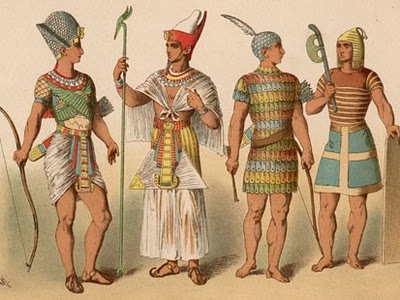
There were forts which were specially built to establish a military base there. Standing army was used in the New Kingdom period. The military men used bows and arrows, spears, shields with round tops made from animal skin as their weapons. The old shields were not replaced by those made out of solid wood that had a bronze buckle, even spears had bronze points. The use of Khopesh was also known. It was borrowed from the Asian soldiers.
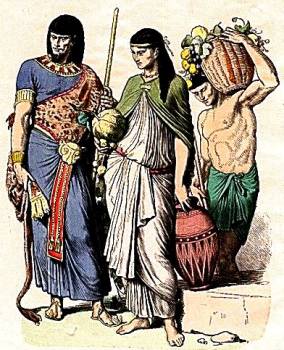
The clothes fashion was simple in the initial years of the Egyptian rule but it became complex at the fag end of the New Kingdom. Clothes pattern was determined by the occupation of a person. Farmers wore short skirts while a poor person wore fewer clothes. |

| Money & Coins | Recreation Part 1 | Trading of Goods |
| Famous Monuments | Recreation Part 2 | Translation Of Hieroglyphics |
| Mummies / Mummification | Religion Part 1 | Transportation System |
| Music in Ancient Egypt | Religion Part 2 | Viziers Ranking |
| Musical Instruments | Religious Beliefs | Famous Wars Fought |
| Myths Part 1: Creation, Eye of Ra | Sarcophagus | Weaponry & Chain of Command |
| Myths Part 2: Death | Children's Schools | Common Weapons Used in War |
| Names and Meanings | Science and Technology | Women's Life Part 1 |
| Numbering System | Role of Scribes | Women's Life Part 2 |
| Obelisks Designs | Life of Slaves & Slavery | Status of Women |
| Paintings Style, Colours | Social Classes in Ancient Egypt | British Museum and Ancient Egypt |
| Papyrus Invention | Soldiers in the Army | Burial Tombs In Ancient Egypt |
| Pharaohs Dynasties | Sphinxes - majestic monuments | Concept of Afterlife |
| Pottery Designs | Common Sports Played | Farming In Ancient Egypt |
| Priests' Role | Famous Statues | Common Food and Drink |
| Process Of Embalming | Symbols and Meanings | King Tutankhamun of Egypt |
| Famous Proverbs | Tattoos and Designs | Sun God: Ra |
| Queens Part 1: Cleopatra | Technology Advancements | The Pyramids of Ancient Egypt |
| Queens Part 2: Other Queens | Temples' Significance | Valley of The Kings |
| Popular Quotes | Commonly used Tools | Pictures/Photos |
