Myths Part 2 |
| Death: Egypt had a unique belief system, of which the most important was the beliefs about the soul and afterlife. The ba was the body and ka, the soul. The intestines, lungs, liver and the stomach were preserved separately and stored in Canopic jars protected by the four sons of Horus. The Book of the Dead were a series of almost two hundred sectional texts, songs and pictures written on papyrus, individually customised for the deceased, which were buried along with the dead in order to ease their passage into the underworld. Opening of the mouth: 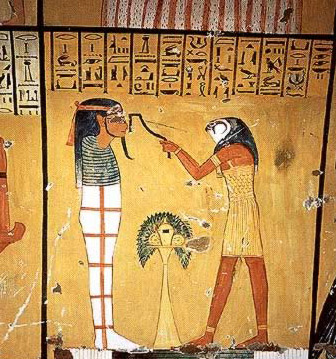 Once the funeral proceeded and the mummy reached its destination, the Opening of the Mouth Ceremony was performed. This allowed the body to eat, breathe and talk again. It was used on statues as well as the dead, to animate the statue. The priest would use an adz or a knife to touch the lips and open them. Final judgment: The soul of the deceased is led into a hall of judgement in Duat, by Anubis, god of mummification, and the deceased's heart, which was the record of the morality of the owner, is weighed against a single feather representing Ma'at'. Maat symbolises truth and order. If the outcome is favourable, the deceased is taken to Osiris, god of the afterlife, in Aaru, but the demon Ammit destroys those hearts that the verdict is against, leaving the owner to remain in Duat. 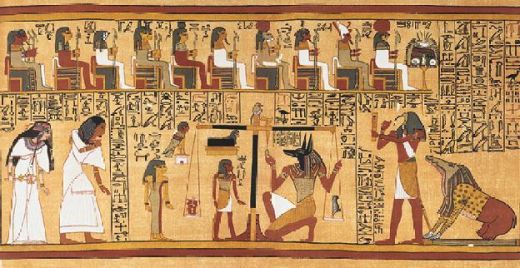 The creator of all things was either Re, Amun, Ptah or Aten, depending on which version of myth was currently in use. The heavens were represented by H athor, Bat and Horus. Osiris was an earth god as was Ptah. The annual flooding of the Nile was Hapi. Storms, evils and confusion were Seth. His counterpart was Ma'at, who represented balance, justice and truth. The moon was Thoth and Khonsu. Ra, the sun god, took on many forms, and transcended most of the borders that contained the other gods. |

| Money & Coins | Recreation Part 1 | Trading of Goods |
| Famous Monuments | Recreation Part 2 | Translation Of Hieroglyphics |
| Mummies / Mummification | Religion Part 1 | Transportation System |
| Music in Ancient Egypt | Religion Part 2 | Viziers Ranking |
| Musical Instruments | Religious Beliefs | Famous Wars Fought |
| Myths Part 1: Creation, Eye of Ra | Sarcophagus | Weaponry & Chain of Command |
| Myths Part 2: Death | Children's Schools | Common Weapons Used in War |
| Names and Meanings | Science and Technology | Women's Life Part 1 |
| Numbering System | Role of Scribes | Women's Life Part 2 |
| Obelisks Designs | Life of Slaves & Slavery | Status of Women |
| Paintings Style, Colours | Social Classes in Ancient Egypt | British Museum and Ancient Egypt |
| Papyrus Invention | Soldiers in the Army | Burial Tombs In Ancient Egypt |
| Pharaohs Dynasties | Sphinxes - majestic monuments | Concept of Afterlife |
| Pottery Designs | Common Sports Played | Farming In Ancient Egypt |
| Priests' Role | Famous Statues | Common Food and Drink |
| Process Of Embalming | Symbols and Meanings | King Tutankhamun of Egypt |
| Famous Proverbs | Tattoos and Designs | Sun God: Ra |
| Queens Part 1: Cleopatra | Technology Advancements | The Pyramids of Ancient Egypt |
| Queens Part 2: Other Queens | Temples' Significance | Valley of The Kings |
| Popular Quotes | Commonly used Tools | Pictures/Photos |
