Obelisks |
| Ancient Egyptians are renowned for their architectural capabilities. With primitive technologies and manual labour, they created wonders in the form of Pyramids. The obelisk symbolized the sun god Ra and it was thought that the structure possessed magical powers and it protected the temples and tombs. An obelisk is basically a monumental tapering column carved from a single block of stone. It was capped with a pointed top. 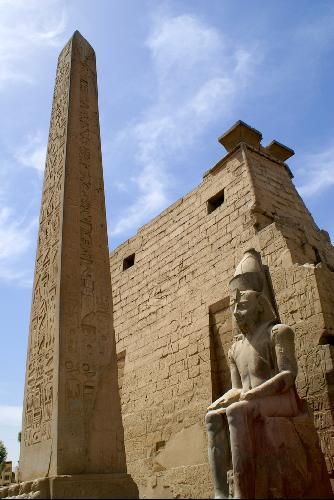 The procedure for building obelisks was similar to that of the pyramids. Both had minimum base with maximum height. However, the methods used for the erection of these constructions are still unknown. On each side of the obelisk a line of carved inscriptions of hieroglyphics containing the titles of the Pharaoh and praising the god was seen. Old and Middle Kingdom obelisks of large scale are from Heliopolis, the centre of the cult of the sun. Obelisks reached perfection during the New Kingdom. Obelisks were placed in pairs at the entrance of temples (also in some tombs). As they were related with the worship of sun, they were placed only in front of those temples which were associated with the sun god. They were even categorised as 'minor obelisks' and 'giant or major obelisks'. The famous and prominent are the latter. The major obelisks had a height ranging from 9 to 32 metres. The tip of the structure was covered in shining metal like gold and it would catch and reflect the first ray of the sun. The smaller ones had heights below 7 metres. Some obelisks were higher than the temples. There are 26 known Egyptian obelisks preserved in different parts of the world. The Obelisk of Queen Hatshepsut at Karnak is one of the most famous obelisks. It has a height of 30 metres and weight of 300 tons. It is the tallest obelisk in Egypt and is made of red granite. Some others are Obelisk to the Pharaoh Tuthmosis I, Karnak Temple, Luxor, Obelisk to the Pharaoh Ramses II, Luxor Temple, Obelisk to the Pharaoh Ramses III, Obelisk to the Pharaoh Seti II, Karnak Temple, Luxor, Luxor Museum and Obelisk to the Pharaoh Sesostris I, Heliopolis, Cairo. Obelisk to the Pharaoh Ramses II, Luxor Obelisk is at the Concorde, Paris, France. The word Obelisk is originally derived from the Greek word obeliskos meaning "needle". Obelisks were usually erected to commemorate some important event, such as a festival celebration, a victory in battle, or sometimes simply as a major gift to the gods. Egyptian obelisks are being re- erected today. |

| Money & Coins | Recreation Part 1 | Trading of Goods |
| Famous Monuments | Recreation Part 2 | Translation Of Hieroglyphics |
| Mummies / Mummification | Religion Part 1 | Transportation System |
| Music in Ancient Egypt | Religion Part 2 | Viziers Ranking |
| Musical Instruments | Religious Beliefs | Famous Wars Fought |
| Myths Part 1: Creation, Eye of Ra | Sarcophagus | Weaponry & Chain of Command |
| Myths Part 2: Death | Children's Schools | Common Weapons Used in War |
| Names and Meanings | Science and Technology | Women's Life Part 1 |
| Numbering System | Role of Scribes | Women's Life Part 2 |
| Obelisks Designs | Life of Slaves & Slavery | Status of Women |
| Paintings Style, Colours | Social Classes in Ancient Egypt | British Museum and Ancient Egypt |
| Papyrus Invention | Soldiers in the Army | Burial Tombs In Ancient Egypt |
| Pharaohs Dynasties | Sphinxes - majestic monuments | Concept of Afterlife |
| Pottery Designs | Common Sports Played | Farming In Ancient Egypt |
| Priests' Role | Famous Statues | Common Food and Drink |
| Process Of Embalming | Symbols and Meanings | King Tutankhamun of Egypt |
| Famous Proverbs | Tattoos and Designs | Sun God: Ra |
| Queens Part 1: Cleopatra | Technology Advancements | The Pyramids of Ancient Egypt |
| Queens Part 2: Other Queens | Temples' Significance | Valley of The Kings |
| Popular Quotes | Commonly used Tools | Pictures/Photos |
