Home Ancient Egypt
Egyptian Canopic Jars
Interesting Facts
Nile River Importance
Physical Features
Timeline of Egypt
Afterlife Concept
Egyptian Amulets
Animals in Ancient Egypt
Egyptian Architecture
Artifacts & Art
Artwork & Artisans
Egyptian Astronomy
Boats / Ships
Bread Making
Calendar Concept
Cats Significance
Cities and Towns
Weather / Climate
Dressing / Clothing
Ancient Egypt Costumes
Ancient Egypt Culture1
Egyptian Culture2
Ancient Egypt Culture3
Ancient Egypt Currency
Curses Belief
Ancient Egypt Customs
Daily Life of People
Deities Names
Diet & Food Habits
Economy & Trade
Education System
Egyptian Engineering 1
Egyptian Engineering 2
Facts for Kids
Farming & Agriculture
Ancient Egypt Gods1
Ancient Egypt Gods2
Ancient Egypt Gods3
Egyptian Government
Egyptian Headress
Egyptian Hieroglyphics
Ancient Egypt Homes
Houses Information
Egyptian Inventions 1
Egyptian Inventions 2
Egyptian Irrigation
Egyptian Jewellery
Jobs & Occupations
Kids / Children's Life
Egyptian Language
Egyptian Legal System
Ancient Egypt Location
Temple of Luxor
Ancient Egypt Marriages
Masks Designs
Maths & Number System
Egyptian Medicines
Ancient Egypt Military
More Articles
More Information
Ancient Egypt FAQ
 

Facts


Continued from home page:

Religious Beliefs

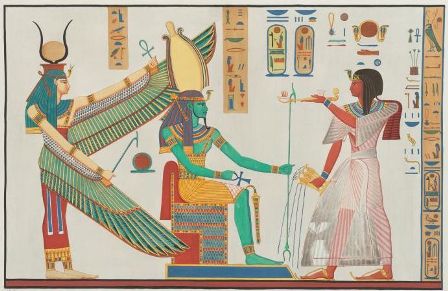
The ancient Egyptians strongly believed in God and life after death. The rule of Pharaohs was laid on the foundation of Divine Rights of Kings. The Egyptians were of the view that to please gods they should make some offerings and pray to god. Gods were worshiped in temples that were under the care of the priests who acted on behalf of the King.
ancient-egyptian-facts
The statue of the God was placed in the heart of the temple. It was only on selected few occasions that the statue of the god was open for public worship. After the New Kingdom, the role of the King as a mediator between God and people received less emphasis. In fact, the priests created a system of revelation wherein people could directly communicate with God.

Another dominant belief was that humans are made of physical and spiritual aspects and every individual has his own shadow, soul, life force and a name. It was believed that heart was the place for emotions and thoughts. After the death of the person, the final goal of the deceased was to unite his life force and soul to be regarded as the 'blessed dead'.

Culture of Ancient Egypt

The culture consisted of housing patterns, food, architecture, etc. The Egyptians had a staple diet of bread, beer along with vegetables like onions, garlic, fruits like date and fig.

Meat and wine were consumed by everyone in general on certain occasions while the rich had it very frequently. The social ranking of an individual was a deciding factor in the food he could consume.

The rich could afford a variety of food items while the poor were forced to stick to the normal food they could afford. Beer and Wine were customary drinks for all classes.

Honey was used instead of sugar. Butter and cheese was served at banquets held by the rich. The average people lived in mud-bricks while the rich people lived in double-thick bricks which controlled the room temperature.

Nobles living in palaces had huge structures and ornamented walls and floors. Construction of buildings was sanctioned and funded by the state for religious purposes. It also symbolized the re-inforcing the power of the Pharaoh.

Language of Ancient Egypt

Egyptian is an Afro-Asiatic language which was spoken in Egypt till the 10th century AD. The language is associated to Berber and Semitic languages like Arabic and Hebrew. After this period, it continued to be in use as the liturgical language of the Egyptians, Christians, Copts. The Old Egyptian language was spoken for around 500 years from 2600 BC onwards.

It was the language spoken in the Old Kingdom and First Intermediate Period. Middle Egyptian was spoken for around 700 years from 2000 BC. It was often dubbed as Classical Egyptian and was known from various textual evidence. It however survived till some centuries AD despite the usage of Late Egyptian language.

Latin was spoken in the middle ages. Demotic was a spoken language till the 5th century AD. Demotic language is a mixture of Egyptian script derived from northern forms of hieratic that was prevalent in the Delta and the stage of Egyptian language between Late Egyptian and preceding Coptic period. Coptic was the last language that was adopted by the ancient Egyptians.


Money & Coins Recreation Part 1 Trading of Goods
Famous Monuments Recreation Part 2 Translation Of Hieroglyphics
Mummies / Mummification Religion Part 1 Transportation System
Music in Ancient Egypt Religion Part 2 Viziers Ranking
Musical Instruments Religious Beliefs Famous Wars Fought
Myths Part 1: Creation, Eye of Ra Sarcophagus Weaponry & Chain of Command
Myths Part 2: Death Children's Schools Common Weapons Used in War
Names and Meanings Science and Technology Women's Life Part 1
Numbering System Role of Scribes Women's Life Part 2
Obelisks Designs Life of Slaves & Slavery Status of Women
Paintings Style, Colours Social Classes in Ancient Egypt British Museum and Ancient Egypt
Papyrus Invention Soldiers in the Army Burial Tombs In Ancient Egypt
Pharaohs Dynasties Sphinxes - majestic monuments Concept of Afterlife
Pottery Designs Common Sports Played Farming In Ancient Egypt
Priests' Role Famous Statues Common Food and Drink
Process Of Embalming Symbols and Meanings King Tutankhamun of Egypt
Famous Proverbs Tattoos and Designs Sun God: Ra
Queens Part 1: Cleopatra Technology Advancements The Pyramids of Ancient Egypt
Queens Part 2: Other Queens Temples' Significance Valley of The Kings
Popular Quotes Commonly used Tools Pictures/Photos

This page last updated in Jan 2014
Copyright 2014 - All rights reserved