Music |
| The people of Egypt lived a merry life finding time for leisure, music and dance. The music and singing in the life of Egypt had considerable attention since the 1st Dynasty, 3000 BC. Scenes in temples and tombs showing musicians playing indicate that music played a vital role in their social life. More information on Ancient Egypt Music Egyptians had a polytheistic religion; they worship innumerable number of gods and goddesses. Worship of god is naturally associated with music. There were even gods specifically associated with music, such as Hathor and Bes. Music had a central role in religious rituals, hymns and prayers. 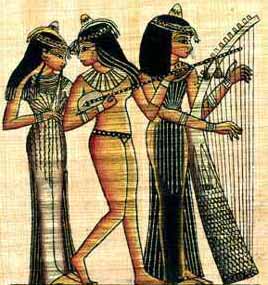 One of Hathor's titles was "mistress of music" and she was considered the goddess of singers. Bes was often depicted playing instruments. Music found its way into many contexts in Egypt: temples, palaces, workshops, farms, battlefields and the tombs. Perhaps the highest status belonged to temple musicians; the office of "musician" to a particular god or goddess was a position of high status frequently held by women. Musicians connected with the royal household were held in high esteem, as were certain gifted singers and harp players. Professional musicians were well paid and mostly were women. Somewhat lower on the social scale were musicians who acted as entertainers for parties and festivals, frequently accompanied by dancers. Musical instruments ranged from very simple, such as percussion instruments, to very complex, such as harps. The simplest instruments were human hands. Clapping was depicted on many walls as being a large part of most musical performances. Drums were also popular. Musical instruments include Barrel drums, clappers, Cymbals, Trumpet, type of oboe, pipes, Clarinet, flute, harp etc. But details of Egyptian notes and composition are unknown to us. |

| Money & Coins | Recreation Part 1 | Trading of Goods |
| Famous Monuments | Recreation Part 2 | Translation Of Hieroglyphics |
| Mummies / Mummification | Religion Part 1 | Transportation System |
| Music in Ancient Egypt | Religion Part 2 | Viziers Ranking |
| Musical Instruments | Religious Beliefs | Famous Wars Fought |
| Myths Part 1: Creation, Eye of Ra | Sarcophagus | Weaponry & Chain of Command |
| Myths Part 2: Death | Children's Schools | Common Weapons Used in War |
| Names and Meanings | Science and Technology | Women's Life Part 1 |
| Numbering System | Role of Scribes | Women's Life Part 2 |
| Obelisks Designs | Life of Slaves & Slavery | Status of Women |
| Paintings Style, Colours | Social Classes in Ancient Egypt | British Museum and Ancient Egypt |
| Papyrus Invention | Soldiers in the Army | Burial Tombs In Ancient Egypt |
| Pharaohs Dynasties | Sphinxes - majestic monuments | Concept of Afterlife |
| Pottery Designs | Common Sports Played | Farming In Ancient Egypt |
| Priests' Role | Famous Statues | Common Food and Drink |
| Process Of Embalming | Symbols and Meanings | King Tutankhamun of Egypt |
| Famous Proverbs | Tattoos and Designs | Sun God: Ra |
| Queens Part 1: Cleopatra | Technology Advancements | The Pyramids of Ancient Egypt |
| Queens Part 2: Other Queens | Temples' Significance | Valley of The Kings |
| Popular Quotes | Commonly used Tools | Pictures/Photos |
